










Self-driving trucks have arrived.
Even as legislation lags behind, driverless trucks are hitting the roads in Texas, Florida, and Northwest Arkansas (where Tyson Foods recently began a partnership with autonomous driving company Gatik AI). What does this mean for drivers in Arkansas?
Well, if the thought of a 50,000-pound big rig barrelling down the highway with nobody behind the wheel frightens you, you’re not alone. Though self-driving trucks have a strong safety record and their technology is advancing rapidly, accidents involving self-driving trucks still occur, and determining who’s to blame for these accidents can become complicated.
Our truck wreck attorneys at Rainwater, Holt & Sexton are here to walk you through the essentials. We’ll explore the technology behind self-driving trucks, discuss the risks they pose to drivers, and help you understand what next steps to take after self-driving truck accidents in Arkansas.
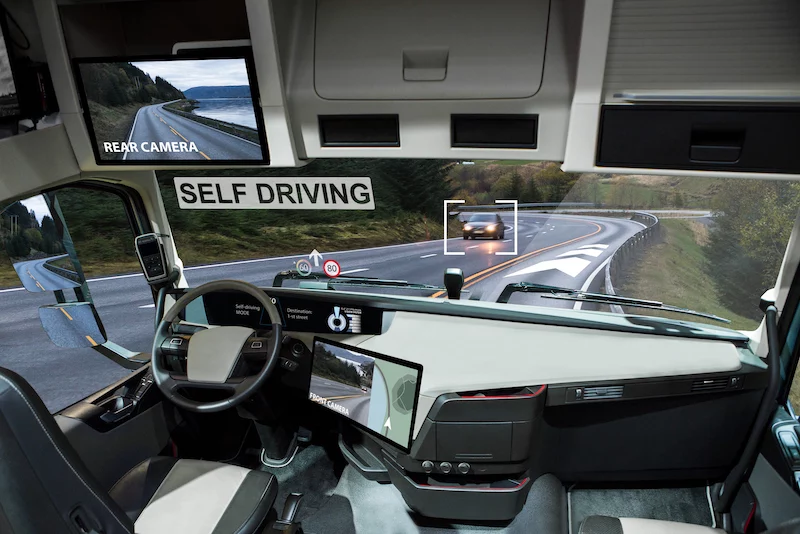
Self-driving trucks operate a lot like self-driving cars. A variety of sensors, like cameras, lidars, and radars, send data to computers onboard the vehicle. These computers control the car using a combination of simulation, training, and programming.
It’s important to keep in mind that, for now, many self-driving trucks will have a driver behind the wheel who is responsible for monitoring the progress of the truck and intervening if trouble arises. The Society of Automotive Engineers (SAE) defines six levels of driving automation:
Most self-driving trucks today are either level 2 or level 3, so human involvement and attention is required for safety. However, many companies are developing level 4 and level 5 vehicles, making it likely that completely driverless trucks will be on the highways before 2030.
Compared to passenger cars, large trucks may be better self-driving vehicles because their size allows for the mounting of sensors higher off the ground, offering an improved field of view.
Trucks need to be able to see and sense conditions much further in advance than passenger vehicles. Because of their weight,they need additional time to stop to avoid serious accidents, and they’re often traveling sixty miles an hour or faster on our nation’s highways. Cameras in leading autonomous trucks can see up to 1,000 yards ahead to scan for traffic and hazards on the road.
Because 95 percent of commercial truck routes involve driving on interstate and freeways, their autonomous systems are quickly becoming viable for longer trucking routes. Self-driving cars and trucks must account for urban settings and be able to stop suddenly for pedestrians or for distracted drivers who run red lights, to avoid accidents in Arkansas. Commercial driving vehicles on the open highway often do not need to account for such unexpected events.
While the logistics of automated trucking continue to evolve, many trucking companies are leaning into a “hub-to-hub” model to maximize safety and efficiency.
In this model, a fully loaded truck will drive autonomously from one hub (for example, Dallas) to another (for example, Houston). Once they arrive at their hub, these trucks will park and wait for a human truck driver to take them to their final, local destination.
Generally, technology for self-driving trucks is advancing faster than state legislation — however, at least two dozen states (including Arkansas) allow for driverless operations. Independent trucking companies must register their technology in multiple states and comply with the various rules of each county and municipality.
Legislators and advocates (both those in favor of and against self-driving trucks) are paying close attention to developments in the safety and viability of autonomous trucking, and our team at Rainwater, Holt & Sexton expects the legal landscape to continue to shift alongside advancements in technology. These advancements will also impact liability in self-driving truck collision cases in Arkansas.
Self-driving trucks bring several benefits to America’s highways: for example, the ability to travel during the least congested hours of the night and a reduction in accidents caused by driver fatigue. However, autonomous trucking technology is far from perfect. Here are the main causes of self-driving truck crashes in Arkansas.
Most often, autonomous trucking accidents are the result of software malfunction. When the software fails to recognize a hazardous situation, it cannot take appropriate action, which can result in deadly accidents. One such accident occurred when the self-driving truck could not identify a pedestrian in a crosswalk as a hazard.
For now, many self-driving trucks still have drivers who are supposed to take control of the truck when there is a problem or hazard. However, if these drivers are distracted, they may fail to take control in time.
When self-driving trucks operate on the open freeway, they are usually driving at a high speed. This speed can make it difficult for human operators to take control and react appropriately when a hazardous situation arises, such as ice on the road, a suddenly stopped car, or even a deer crossing the road.
Self-driving trucks can still crash due to negligent maintenance and care. When a trucking company cuts corners or fails to maintain its fleet, serious accidents can occur. Failures can include:
Despite their cutting-edge technology, self-driving trucks can be dangerous. “Drivers” of self-driving trucks need to remain alert and focused on the road at all times. That way, when a hazardous condition arises, they can take the wheel and maneuver the truck safely. Unfortunately, as the truck drives smoothly on the open road, many drivers get bored and look for other ways to keep themselves entertained. Using cellphones, napping, or even watching movies may be ways that truck drivers keep themselves engaged while the truck drives. When an emergency occurs, they are then unable to steer the truck out of harm’s way.
Another risk of self-driving trucks is that their software may be a prime target for hackers or domestic terrorists. If the software system is hacked, the hackers can take control of the truck or even cause accidents themselves.
Let’s review two real-world examples of collisions to better understand the dynamics of a self-driving truck crash in Arkansas.
As Waymo’s self-driving truck hauled a trailer northbound on I-45 toward Dallas, Texas, another truck entered the lane right in front of it, pushing Waymo’s truck off the highway and into a guardrail on the side of the road.
Though there was a driver behind the wheel of Waymo’s vehicle, they didn’t intervene as the truck made its way off the road. The driver was taken to the hospital with moderate injuries.
Waymo wasn’t found to be at fault for the accident, but the incident did highlight how autonomous vehicles have trouble navigating errors from other drivers. At the end of the day, self-driving truck crashes will always be a possibility because the nature of driving is so unpredictable.
Unlike Waymo, TuSimple was found to be at fault for a crash that occurred on the I-10 in Tucson, Arizona.
While traveling at a high speed on I-10, a semi-trailer truck operated by TuSimple suddenly veered left, cutting through a lane of traffic and slamming into the concrete highway divider. Fortunately, no one was injured in the collision, but it did provide an example of how advanced autonomous driving technology can still make serious mistakes.
In this instance, the truck executed a left turn because of a 2.5-minute old command in its autonomous driving system — a command that should have been wiped from the system long before. Initially, TuSimple blamed the crash on driver error (for failing to reboot the system properly), but eventually acknowledged that faulty technology played a part. Their driving system shouldn’t have followed an old command, and safeguards should have been in place to prevent sharp turns at high speeds.
TuSimple grounded its fleet and swiftly made software fixes. Still, it’s crucial that drivers be aware that self-driving technology is imperfect and remain alert and focused when driving next to big trucks on Arkansas’ highways to avoid wrecks.
When a self-driving truck gets into an accident with another vehicle, pedestrian, or bicyclist in Arkansas, multiple parties can share the blame.
Self-driving trucks are new, and the chain of liability is not always clear after an accident. These accidents need to be investigated thoroughly to ensure that all responsible parties are held accountable.
Self-driving truck accidents are rare. But as the technology evolves and more and more driverless trucks hit the streets, accidents involving self-driving trucks will inevitably increase. At Rainwater, Holt & Sexton, our truck accident attorneys stay abreast of all local and state trucking laws and regulations. We realize that the trucking industry is changing and that new technology will further this change, and we’re committed to navigating these changes with prudence and care.
Did you or someone you love suffer an injury in an accident involving a self-driving truck?
If so, you need a law firm on your side with experience handling self-driving truck accidents in Arkansas. With offices throughout Arkansas – Little Rock, Springdale, Conway, Hot Springs, Bryant, Jacksonville, and Jonesboro—our truck accident lawyers can tackle cases from across both states.
Fill out a free contact request form, which only takes a minute, or simply dial (501) 868-2500 and tell us your story. Call us today!
 N/a
N/a